
Licensure Manager
Designing a licensure and continuing education management tool for licensed professionals, from research to prototype.
Project Type
UX Research, Product Discovery, UX/UI, Prototyping, Usability Testing
Length
2 months
Role/Teams
Researcher & Designer (👋🏽), Engineer (contract), Clinical Advisors (SMEs)
Background
Millions of licensed professionals across the United States, including social workers, nurses, accountants, teachers, and personal trainers, are required to complete continuing education units (CEUs) to maintain their active licenses. For professionals holding multiple licenses or credentials, the challenge of tracking, logging, and ensuring compliance is significant. Despite the scale of this need, no simple, free, and cross-profession solution exists.
Summary
I led end-to-end product discovery and design for Manage: CEU, a web-based application designed to help licensed professionals track, manage, and stay audit-ready with their continuing education requirements. Starting from zero, I conducted a full research cycle including market analysis, competitive benchmarking, user interviews, contextual inquiry, affinity mapping, and usability testing before delivering a tested, iterated prototype.
Problem
A comprehensive and accessible CEU tracker for licensed professionals does not exist. Existing solutions are either profession-specific, gated behind expensive enterprise software, or too complicated for individual use. Professionals are left cobbling together spreadsheets, emails, and peer advice to manage requirements that directly affect their ability to practice.
USER RESEARCH
KEY FINDING. Licensed professionals across industries share a consistent, frustrating experience: CEU management is complicated, stressful, and poorly supported by existing tools.
To understand the problem space, I conducted nine user interviews and one contextual inquiry with licensed professionals spanning nursing, social work, accounting, and fitness training. I developed a full research plan, interview guide, and synthesis framework before conducting and analyzing sessions.
Core research objectives:
Understand how professionals plan, earn, and track CEUs
Identify pain points in current processes and tools
Determine willingness to pay and feature priorities
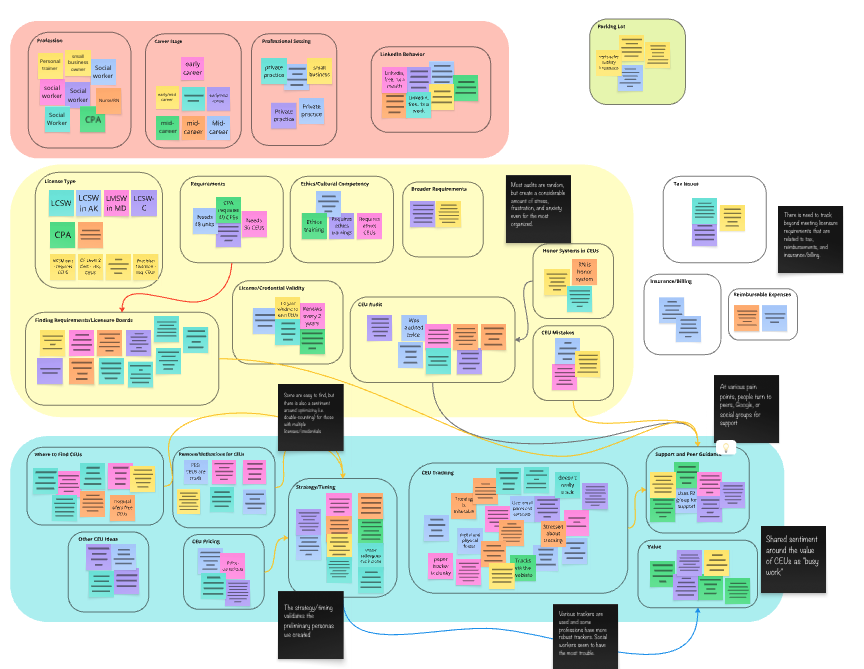
Key findings from interviews and affinity mapping:
Tracking and managing CEUs was the most cited pain point. The majority of interviewees had no reliable system and described piecing together certificates across emails, desks, and binders, with the anxiety of not knowing if they could pass a random audit.
Fear of audits was pervasive. Failure to comply can result in a revoked license and inability to practice. Several interviewees described anxiety around compliance even when they believed they had completed their requirements.
Cost creates inequity. Employer reimbursements ranged from $0 to $4,500 per year. Early-career professionals and those without reimbursement were most impacted, often settling for low-cost CEUs with limited relevance to their work.
Most CEUs are completed last-minute. Deadline pressure forced users to choose the quickest, cheapest option rather than coursework with professional value. Many described this as "busy work."
Peer networks filled the gap. In the absence of reliable tools, interviewees turned to Facebook groups, Reddit, and colleague spreadsheets for guidance. This introduced uncertainty about the accuracy of the information.
KEY INSIGHT. The core user need is not finding CEUs. It is confidence: knowing their requirements, knowing they are on track, and knowing they could survive an audit.
“Keeping track of requirements and when new trainings are required takes so much time. Not to mention just trying to find the right website.” - Licensed Social Worker
“I honestly wait until the very last minute. Even though I have this elaborate system of reminders in my planner, notebook, and calendars.” - Certified Fitness Trainer
“My coworkers and I help each other out. If I find a relevant training or something that is low cost or low time commitment I share it out on our group text.” - Registered Nurse
COMPETITIVE ANALYSIS
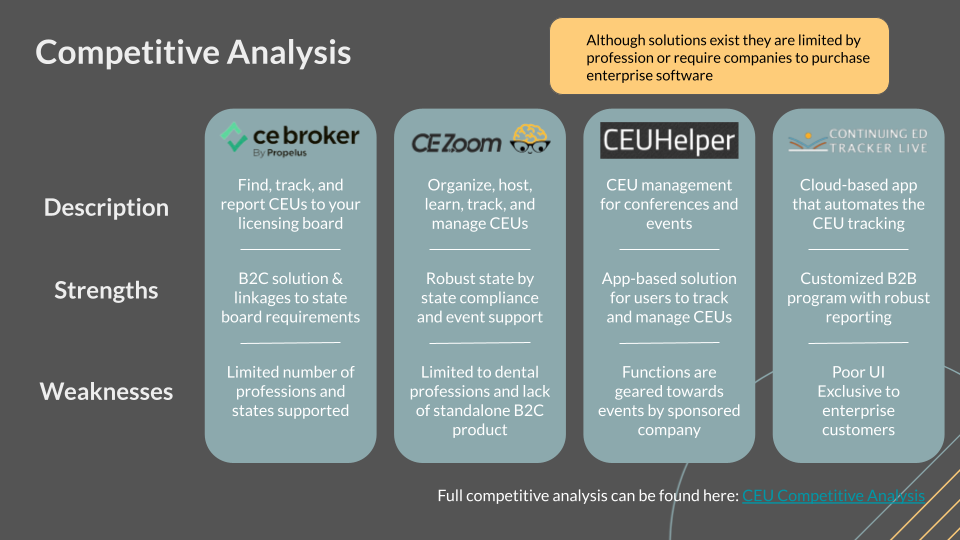
KEY FINDING. Existing solutions are limited by profession, poor UI, or enterprise-only pricing. A cross-profession, B2C solution with a clean experience does not exist.
The opportunity: a simple, affordable, multi-profession tracker that surfaces requirements clearly and helps users manage compliance proactively.
BRAND IDENTITY
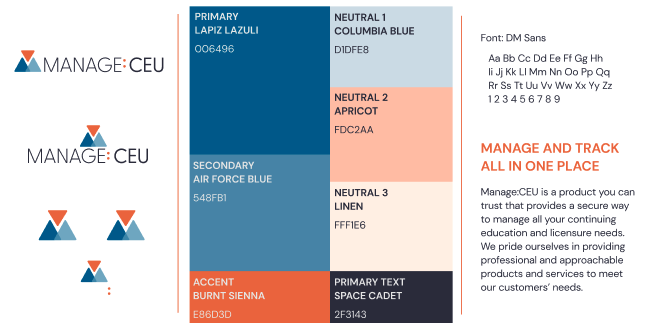
KEY DESIGN DECISION. Developing a full brand identity for Manage: CEU was an intentional step to ground the product in a visual language that reflected the trust and clarity users were seeking.
Following competitive analysis, I developed a complete brand kit for Manage: CEU to establish a cohesive product identity before moving into interface design. Grounding the visual system early ensured that design decisions in the UI were consistent and purposeful rather than made ad hoc during wireframing.
USER PERSONAS
Based on research synthesis, I developed three personas that represent distinct behavioral archetypes across the CEU user spectrum:
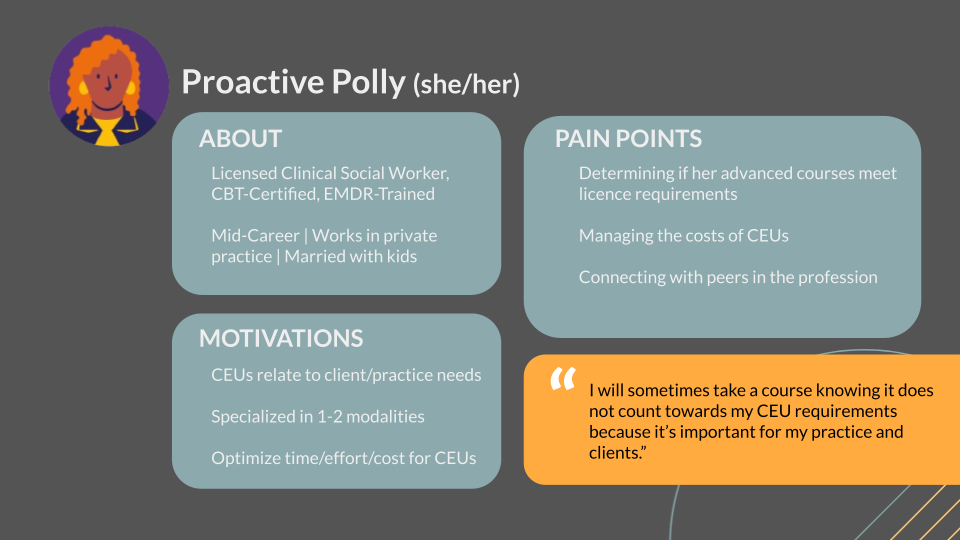
Proactive Polly (Licensed Clinical Social Worker, mid-career) prioritizes CEUs that align to her clinical practice and specializations. Her frustration is determining whether advanced, specialized courses meet her license requirements, and managing the associated costs.
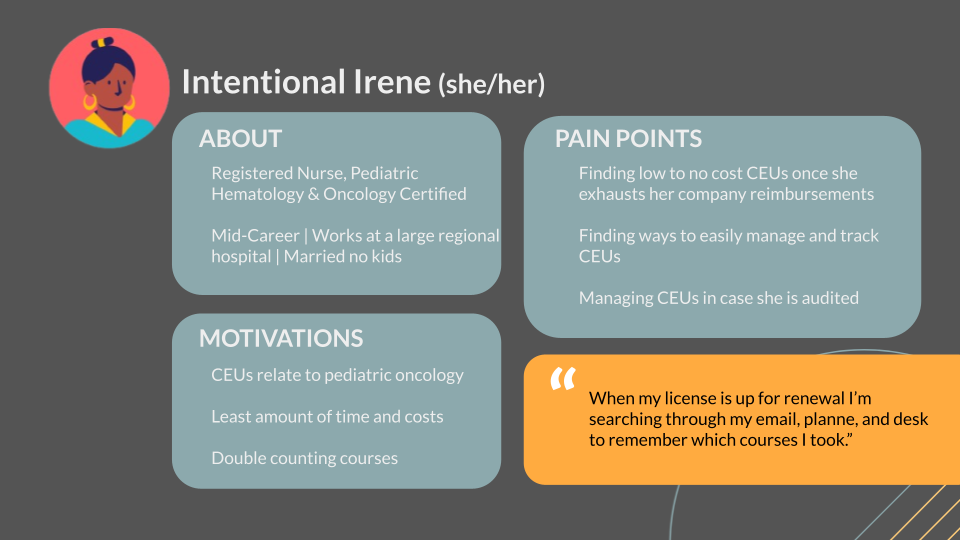
Intentional Irene (Registered Nurse, mid-career) wants CEUs that are relevant to her specialty with minimum time and cost. Her greatest pain point is tracking: at renewal time she is searching across email, planners, and her desk to reconstruct what she completed.
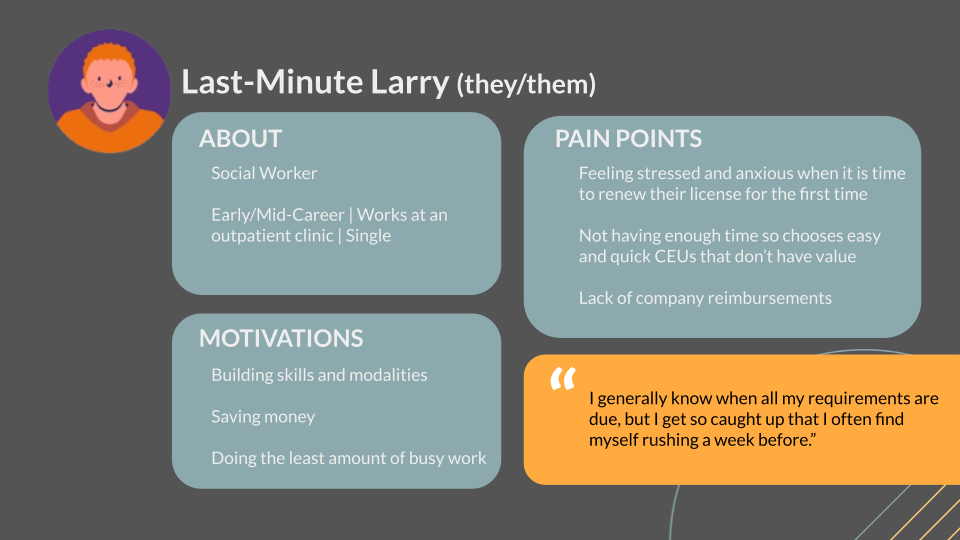
Last-Minute Larry (Social Worker, early/mid-career) knows their deadlines but gets caught up and ends up rushing in the final week before renewal. They default to fast, cheap courses and feel the stress most acutely.
HOW MIGHT WE…
Using findings from interviews and affinity mapping, I facilitated a How Might We exercise to reframe pain points as design opportunities. Key questions that guided the product direction:
How might we make understanding CEU requirements as easy as possible?
How might we eliminate the administrative burden of CEU management completely?
How might we help licensed professionals feel confident if they were to be audited?
How might we help professionals build a CEU plan well before their renewal deadline?
How might we reduce the last-minute crunch and stress around CEU completion?
DESIGN PROCESS
FEATURE SET PRIORITIZATION
-
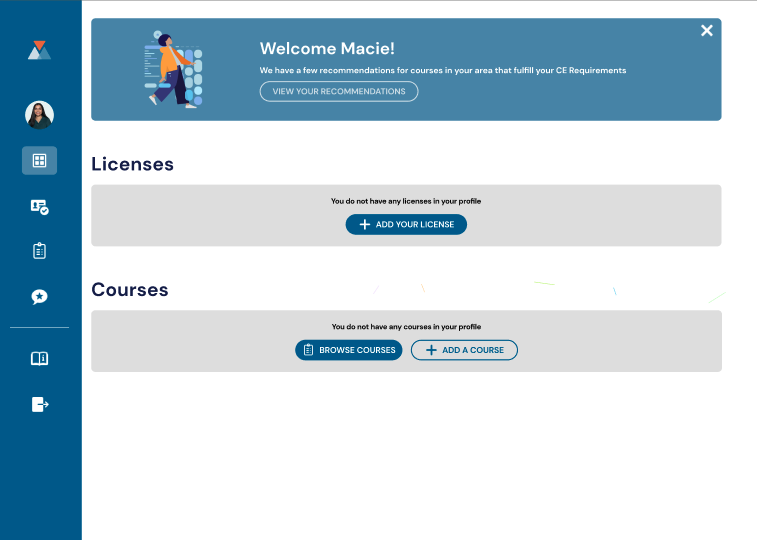
A central view where users can see all active licenses, their CEU progress, and upcoming renewal dates.
Impact:
Reduces the tracking burden that was the most cited pain point across all user interviews.
-
Users can add a license manually or via a URL that auto-imports CEU requirements directly from the licensing board.
Impact:
Eliminates the most error-prone step in the current user process.
-
A consolidated list of completed courses, uploadable certificates, and manual entry for courses taken outside the system
Impact:
Creates an audit-ready record that addresses the anxiety users expressed around compliance.
-
Filterable, searchable course recommendations mapped to license requirements.
Impact:
Reduces last-minute scrambling and increases course relevance.
-
Tracking clinical hours for professionals in the process of earning full licensure.
Impact:
Captures an earlier segment of the market and builds product loyalty.
P0: Critical (must design/implement)
P1: High Priority,
P2: Deprioritized (nice to have)
WIREFRAMES & TESTING
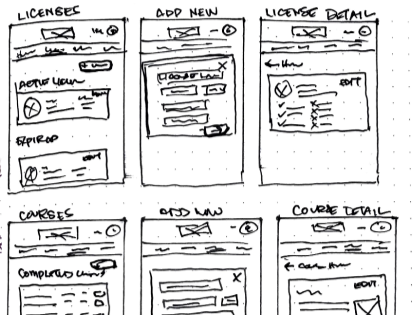
Low fidelity sketches
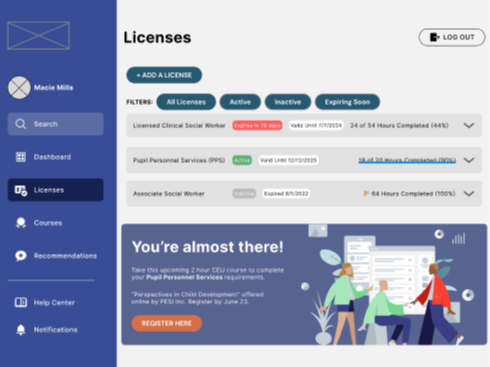
Mid fidelity wireframes
I designed low-fidelity wireframes and a mid-fidelity prototype for usability testing with five participants across the target user groups. Testing covered three primary task flows: adding a new license, viewing license details and CEU requirements, and finding and adding a course.
KEY DESIGN DECISION. The auto-import feature, which pulls CEU requirements directly from a licensing board URL, was the highest-delight moment in testing once users understood it. Clarifying its relationship to the URL field became an immediate P0 iteration.
USABILITY TESTING
KEY FINDING. Users responded strongly to the simplicity of the interface, and the "Expires in..." flag was a standout moment. Friction points were concentrated in labeling and iconography, not flows.
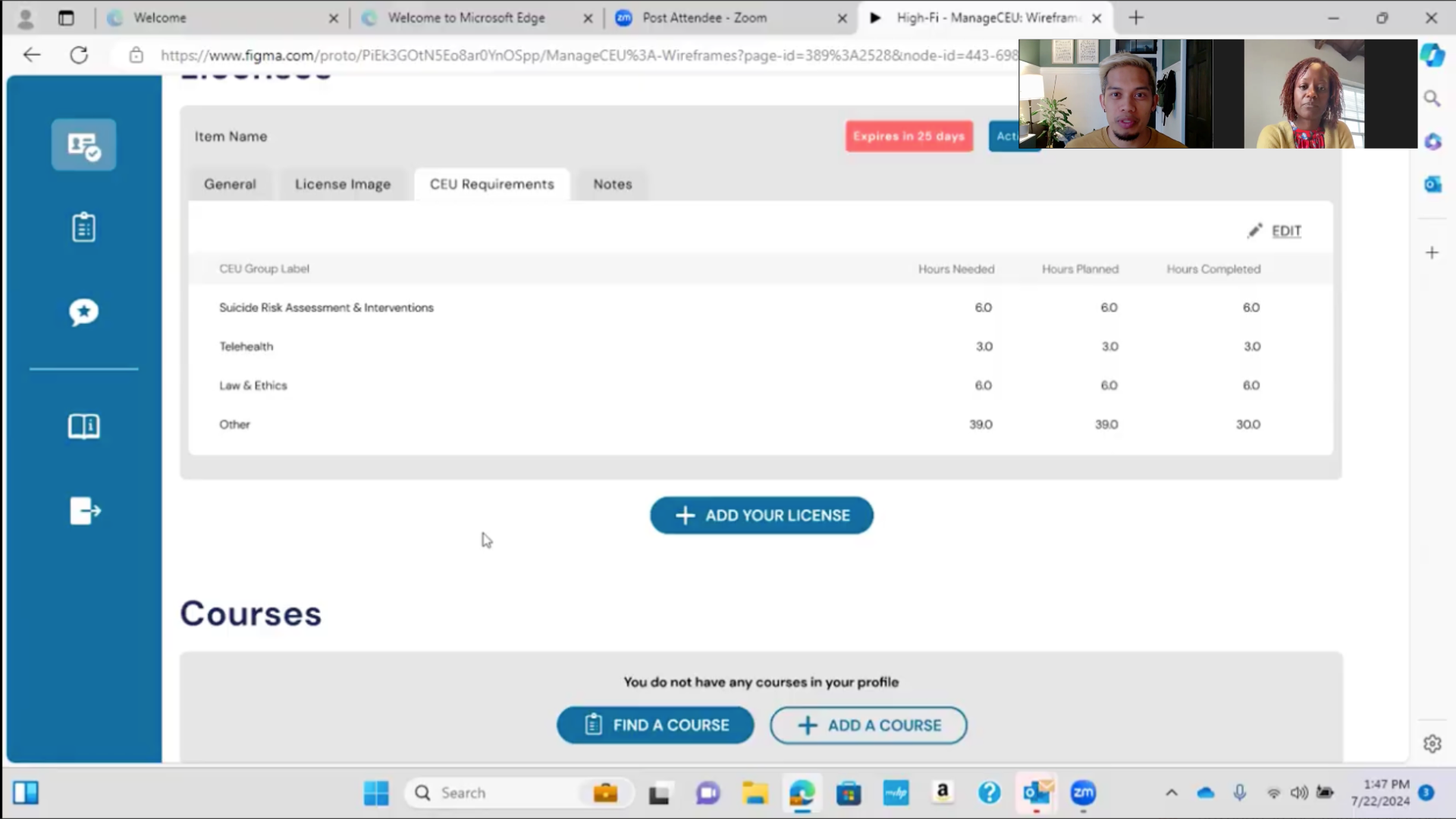
♥️ What users loved:
The uncluttered design kept a complicated concept from feeling overwhelming
Auto-importing CEU requirements via a license URL was a "wow factor" once the connection was understood
Having all courses organized in one place was consistently called out as a differentiator from anything they currently use
The "Expires in..." deadline flag provided immediate, at-a-glance value
🫤 What needed iteration:
Button and CTA labeling in the courses section was unclear; users could not distinguish between "Find a Course," "Browse," and "Add a Course"
Icon meanings were ambiguous and inconsistent across components, requiring clearer affordances
The relationship between the license URL input and the Auto Import button was not obvious on first read
Table alignment and spacing needed adjustment to improve scannability
This project gave me the opportunity to run a full research-to-prototype cycle as both lead researcher and designer. The most important skill it reinforced was letting research drive prioritization rather than assumptions. The auto-import feature, for example, emerged directly from the insight that users found existing requirements difficult to locate and decipher. The “Expires in” flag came from understanding how audit anxiety manifested in behavior.
What I would explore next: filterable course listings as a P0 (users rated this as essential, not optional), a pre-licensure hour tracker to capture early-career professionals before their first renewal, and richer visual indicators in the CEU requirements table to help users understand what needs action at a glance.
FINAL THOUGHTS
View more projects

02 Performance Dashboard